

Language justice, professional ethics, and the human responsibility behind every interpretation General information only; not legal advice.
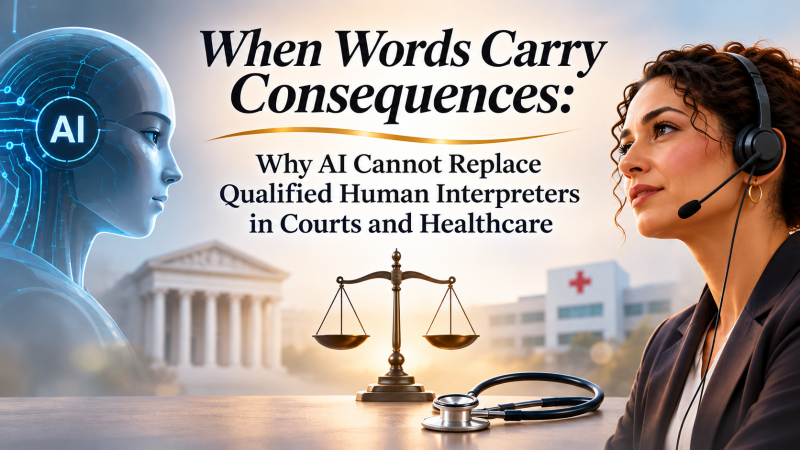
Artificial intelligence is transforming the way we communicate across languages. Its speed, accessibility, and growing capabilities are undeniable. But when communication takes place in a courtroom or a hospital, accuracy is not a matter of convenience. It can determine whether a person receives a fair hearing, understands their legal rights, gives informed consent, or receives appropriate medical treatment.
In these settings, a mistranslation is not merely a linguistic error. It can become a miscarriage of justice or a threat to patient safety.
The question is not whether AI can translate words. It is whether AI can replace the professional judgment, cultural awareness, ethical obligations, and accountability of a qualified human interpreter when the consequences of misunderstanding are potentially devastating.
When a Translation Error Becomes a Legal Failure
Consider a defendant who misunderstands a judge’s question, an asylum applicant whose testimony is inaccurately rendered, or a witness whose statement is altered by a single mistranslated word. In legal proceedings, pronouns, verb tenses, negation, regional dialects, and culturally specific expressions can all influence credibility assessments and judicial decisions.
These concerns are not hypothetical. Courts have already confronted them.
In United States v. Cruz-Zamora, 318 F. Supp. 3d 1264 (D. Kan. 2018), a Kansas Highway Patrol trooper used Google Translate to ask a Spanish-speaking motorist for permission to search his car. The court found that the government had not shown the consent was freely and intelligently given, and it suppressed the evidence. It also held that the good-faith exception did not apply, reasoning that it was not reasonable for an officer to rely on Google Translate to obtain consent to a warrantless search when more reliable options for translation were available.
In Commonwealth v. Carmenates, 266 A.3d 1117 (Pa. Super. 2021) (en banc), the Pennsylvania Superior Court addressed a similar traffic stop in which a trooper and a driver passed a phone back and forth to use Google Translate. A three-judge panel had initially reversed the suppression order in 2020, but the full court later sided with the trial court. Pennsylvania courts have since cited the decision for the principle that a substantial language barrier can render consent invalid.
Both cases involved consumer machine translation, not modern generative AI interpreting systems. But they establish a principle that applies to any automated tool: a translation cannot be presumed accurate simply because it produces an intelligible-sounding response.
The fallout extends well beyond the individuals involved. Inaccurate language assistance can lead to suppressed evidence, invalid consent, appeals, retrials, delays, and significant cost. For attorneys, relying on unverified automated translation may raise questions about competence, diligence, and the protection of clients’ rights. For courts and justice agencies, it can invite constitutional challenges and, where applicable law permits, civil liability. And for the person whose freedom, credibility, or future is at stake, the harm may already be done.
In Healthcare, Misinterpretation Can Be a Matter of Life and Death
The stakes in healthcare are just as high. Imagine a patient whose symptoms are incorrectly communicated to a physician, a medication instruction that loses a critical negative, or a surgical procedure explained in a way the patient cannot fully understand. A seemingly minor error can affect diagnosis, dosing, discharge instructions, and informed consent.
The research is more nuanced than either side of this debate often admits, and it is worth being precise. A 2019 study by Khoong and colleagues in JAMA Internal Medicine tested Google Translate on 100 sets of real emergency department discharge instructions. Most translations were accurate: 92% in Spanish and 81% in Chinese. But that still means roughly one in twelve Spanish translations and nearly one in five Chinese translations contained inaccuracies, and some errors could have caused harm. The most striking example was the instruction to “hold the kidney medicine” (meaning stop taking it), which was rendered in Spanish as “keep the medication” and in Chinese as “keep taking” it. The researchers classified those errors as potentially life-threatening.
The authors themselves “cautiously support” machine translation of written discharge instructions as better than nothing and recommend using it alongside human interpreters. That finding concerns written text, not live interpreting of a conversation, and it is a reminder of what these tools are best suited for. But the lesson is clear: a translation that reads fluently is not necessarily medically accurate, and the errors that matter most are the ones that no one notices.
Under Section 1557 of the Affordable Care Act, covered healthcare organizations must take reasonable steps to provide meaningful access to people with limited English proficiency. The 2024 implementing rule, 45 C.F.R. § 92.201, requires qualified interpreters when interpreting services are provided, and it addresses machine translation directly: when the underlying text is critical to a person’s rights or access, or is complex or technical, the machine translation must be reviewed by a qualified human translator. The rule does not ban machine translation, and in December 2024 the HHS Office for Civil Rights acknowledged that in an emergency, human review may have to come afterward.
It is also worth being precise about the rule’s status. In October 2025, a federal court in Mississippi vacated the provisions of the 2024 rule that treated gender-identity discrimination as sex discrimination, and HHS issued a notice in June 2026 to that effect. The remaining provisions, including the language-access requirements, remain in force.
Technology can help clinicians communicate in urgent situations. But convenience must never be mistaken for a substitute for qualified language assistance, and patients should not bear the medical risk of an institution’s decision to prioritize speed or cost.
What AI Cannot Replace: Judgment, Cultural Awareness, and Accountability
Qualified interpreting is far more than converting words from one language into another. A professional interpreter understands meaning in context, recognizes ambiguity, navigates dialect, and conveys the speaker’s message without additions, omissions, or alterations. Just as important, a qualified interpreter knows when to stop and ask for clarification.
Consider Arabic, a language with many regional varieties. In Gulf Arabic, particularly in Kuwait and Iraq and in some Bahraini and Emirati speech, the word سرك (sirak or sarak) means “street” or “road.” Depending on how it is pronounced, it can be misheard as سيرك, which means “circus.”
Now imagine a witness testifying about an accident. He says he was walking on the سرك at 11 p.m., shortly before midnight. If that word is interpreted as “circus,” his testimony suddenly describes a man strolling through a circus late at night. A judge, jury, or opposing counsel may begin to doubt his credibility, even though the witness said nothing wrong. Only an interpreter who knows the dialect, and who recognizes that the context points to a street, would catch the error before it damages the testimony.
Dialectal flexibility and cultural awareness are therefore not optional extras. They are core components of accurate communication.
Equally important is the interpreter’s professional code of ethics. Qualified interpreters are bound by principles of accuracy, impartiality, confidentiality, professional competence, and respect for the boundaries of their role. They render what is said faithfully, without offering opinions, advocating for a party, or altering the message.
AI systems can perform linguistic tasks, but they do not carry the same professional or ethical accountability. When an interpretation is wrong, who notices? Who asks for clarification? Who is responsible for protecting the integrity of the communication? When institutions hand consequential conversations to automated systems without meaningful human oversight, those questions have no answer.
Language Justice Is a Right, Not a Luxury
Language justice rests on a simple principle: no one should be disadvantaged in accessing justice, healthcare, or essential services because of the language they speak.
In a courtroom, meaningful language access allows a person to understand the proceedings, communicate with counsel, and take part in their own defense or immigration case. In a hospital, it allows a patient to describe symptoms, understand recommendations, ask questions, and make informed decisions. In many circumstances, providing a qualified interpreter is not a courtesy but a legal obligation, and always an essential safeguard of fairness and safety. (In federal courts, for example, the Court Interpreters Act, 28 U.S.C. § 1827, provides for interpreters in proceedings, while state courts and healthcare providers generally rely on state law and on federal civil-rights requirements such as Title VI and Section 1557.)
The consequences of failure are not automatic, but they are real: appeals and new hearings, professional or civil liability for attorneys, civil-rights investigations and malpractice claims for healthcare institutions. The cost of a qualified interpreter should never be weighed in isolation from the far greater human, legal, and financial cost of getting communication wrong.
The Hard Question: What About Access?
A fair critic will raise a serious objection. There are not enough qualified interpreters in every language, at every hour, in every rural court or small clinic. Waiting for an interpreter can delay care, and some institutions cannot afford one. In an emergency, an imperfect translation may be better than silence.
That is true, and it is a reason to act, not a reason to give up. In a genuine emergency, a machine tool may be a necessary bridge, which is exactly why the rules allow qualified review afterward. But a stopgap must not quietly become the standard. The answer to a shortage of interpreters is to invest in recruiting, training, and certifying more of them, and to expand remote options such as telephone and video interpreting delivered by qualified professionals, not to treat the shortage as permission to use unverified automation in the moments that matter most.
Technology Should Support Interpreters, Not Replace Them
Artificial intelligence has a legitimate place in the language-services industry. It can assist with terminology research, preparation, administrative processes, and other appropriately supervised tasks.
But the existence of useful technology does not justify replacing qualified professionals in high-stakes encounters. Courts and healthcare institutions should establish clear language-access protocols, engage qualified interpreters, verify language and dialect proficiency, and make sure interpreters understand the ethical responsibilities of their assignments. Interpreters should be treated not as an optional expense but as essential participants in the delivery of justice and healthcare.
What You Can Do
- If you or a family member needs language help in court or at a hospital, ask for a qualified interpreter. You have the right to request one in many settings, and you should not have to rely on a family member or a phone app.
- If you work in a court, hospital, or law office, check your institution’s language-access policy and ask how interpreters are qualified and when machine translation is permitted.
- If you are an attorney or clinician, confirm the rules that apply in your jurisdiction and, when stakes are high, use a qualified professional.
Conclusion: Human Understanding Is Essential to Language Justice
Language is more than a sequence of words. It carries meaning, intention, emotion, cultural context, and consequences. In legal and medical settings, the responsibility to communicate accurately is too important to delegate entirely to a technology that can produce errors without recognizing their significance.
AI may continue to improve, and it may become a valuable tool in multilingual communication. But technological progress must be measured against the rights and safety of the people it serves.
Because when words carry consequences, accuracy is not optional.
References
- United States v. Cruz-Zamora, 318 F. Supp. 3d 1264 (D. Kan. 2018).
- Commonwealth v. Carmenates, 266 A.3d 1117 (Pa. Super. 2021) (en banc). Please confirm the citation against the court’s opinion before posting.
- Khoong EC, Steinbrook E, Brown C, et al. Assessing the Use of Google Translate for Spanish and Chinese Translations of Emergency Department Discharge Instructions. JAMA Intern Med. 2019;179(4):580-582. doi:10.1001/jamainternmed.2018.7653.
- U.S. Department of Health and Human Services. Nondiscrimination in Health Programs and Activities, 89 Fed. Reg. 37522 (May 6, 2024), codified in part at 45 C.F.R. pt. 92, including § 92.201 (language assistance services and machine translation).
- HHS Office for Civil Rights. Re: Language Access Provisions of the Final Rule Implementing Section 1557 of the Affordable Care Act (Dec. 5, 2024).
- HHS/CMS. Notice of Vacatur Regarding Certain Provisions of the 2024 Nondiscrimination in Health Programs and Activities Rule, 91 Fed. Reg. (June 2, 2026) (notice 2026-11015), regarding Tennessee v. Kennedy (S.D. Miss. Oct. 22, 2025).
- Court Interpreters Act, 28 U.S.C. § 1827.
Disclaimer: The views and opinions expressed in this article are solely my own and are based on my personal perspectives and professional experience. They do not necessarily reflect the views, positions, or policies of any client, agency, organization, or institution with which I am affiliated, for which I provide interpreting services, or with which I have a contractual relationship.
Add comment
Comments